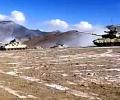
The sources said withdrawal of armoured elements from the south bank of Pangong Tso is almost complete and temporary structures erected by both sides will be demolished in the next few days.

Official sources said withdrawal of tanks and other armoured elements from certain friction points is nearing completion while pulling back of troops from the North bank areas is being undertaken.

The 30-member committee, chaired by senior Bharatiya Janata Party leader and former Union minister Jual Oram and of which Rahul Gandhi is also a member,wishes to visit the eastern Ladakh region in the last week of May or in June.

As per the agreement reached by the two sides, India and China will withdraw the forward deployment in a phased and coordinated manner, the defence minister said.

The Chinese and Indian armies continued with the disengagement process in the North and South banks of Pangong lake in eastern Ladakh as per plan and the entire pullback exercise is expected to take another six-seven days, sources in the defence and security establishment said on Monday.
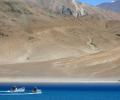
The people familiar with the development said the new bridge is being built in an area that is over 20 km from the Line of Actual Control (LAC).

At a media briefing, External Affairs Ministry Spokesperson Arindam Bagchi said India monitors such developments.
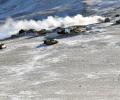
It has been argued that India should have held back on disengagement from the Kailash Range, using that as a trump card to force Chinese concessions in areas such as Depsang, where they hold the advantage.

The Army has also further bolstered overall surveillance mechanisms in all areas along the Line of Actual Control (LAC) in eastern Ladakh after foiling China's fresh attempt to occupy an area on the southern bank of Pangong lake, they said.

The Chinese have only created limited defences for protection of their posts which are located well in depth and much away from the Line of Actual Control, notes Colonel S Dinny (retd).

India on Friday said that a second bridge being constructed by China on Pangong lake is in an area that has been under illegal occupation of that country since 1960.

The government needs to answer the critical question of whether it has accepted any restrictions on its infrastructure creation activities, asserts Ajai Shukla.

Out of 18, four personnel were critically injured but they are responding to treatment and are stable now, people familiar with the matter said.

This is the first time that the defence ministry has admitted officially about the transgressions by the Chinese troops.
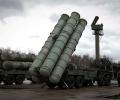
RInstead of disengagement, the Indian and Chinese armies have deployed an estimated 35,000 to 40,000 soldiers each along the LAC. The PLA has deployed S-400 air defence missiles to neutralise the IAF's advantage in air power
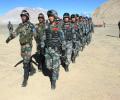
The last time the Chinese military had taken Indian soldiers captive was in July 1962 after a clash in Galwan Valley.

'It is flabbergasting to think that this heavenly region has, for decades, been coveted by India's aggressive neighbours,' says Claude Arpi after a recent visit to Ladakh. 'Wanting to use the newly created infrastructure to defend the borders after the clash of 2020 with China and the resulting standoffs, the home ministry is keen to boost border tourism to show that these areas are controlled by India.'
The ministry also made certain clarifications in the statement, and said, "the assertion that Indian territory is up to Finger 4 is categorically false. The territory of India is as depicted by the map of India and includes more than 43,000 sq km currently under illegal occupation of China since 1962."

Army Spokesperson Colonel Aman Anand said troops from China's People's Liberation Army (PLA) 'violated' the consensus arrived at during military and diplomatic engagements on the ongoing standoff in eastern Ladakh, and carried out provocative military movements to change the status quo.

Air Chief Marshal Bhadauria was at the Leh IAF base on Wednesday where he reviewed operational preparedness of the force in effectively guarding the sensitive border areas in eastern Ladakh where Indian and Chinese armies have been on a nearly six-week standoff.

Since the June 15 clash, the PLA has inducted large numbers of troops, armoured vehicles and artillery along the LAC, from Depsang and Galwan in northern Ladakh to Hot Springs, Pangong Tso, and Chushul in central Ladakh, to Demchok and Chumar in southern Ladakh.

The talks came a day after the two armies began a limited disengagement in a few areas in Galwan Valley and Hot Spring in a demonstration of their intent to end the row peacefully.

India on Wednesday delivered a strong message to China that the 'unprecedented' incident in the Galwan Valley will have a 'serious impact' on the bilateral relationship and held the 'pre-meditated' action by Chinese army directly responsible for the violence that left 20 Indian Army personnel dead.

Indian Army officers are convinced China is maintaining the pretence of dialogue and negotiations in order to create the opportunity to occupy more Indian territory. Senior Indian planners apprehend this might be a Chinese ploy to divert attention from Depsang, in Northern Ladakh, which might be China's actual target.

'If you behave like a nail, the adversary will behave like a hammer.'
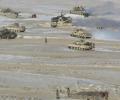
The MEA said there has not been any change in India's position on the LAC and the mutual redeployment as a result of the disengagement process should not be misrepresented.

In his initial remarks, Army Chief General M M Naravane briefed the commanders about the overall situation following which detailed discussions on the matter took place, the sources said.

'The Indian Army is fully prepared for a long and permanent deployment if the PLA does not retreat.'

The visit comes a week after 20 Indian Army personnel were killed in a brutal assault by the Chinese military in Galwan Valley which escalated the border tension.

'If Washington has to balance Chinese power, she will have to turn to the third biggest power in the world which is India.' 'The United States and India will have to work together in order to keep Chinese ambitions in check.'

'For the moment in Eastern Ladakh, it is unlikely there will be any more escalation of this conflict,' observes Colonel S Dinny (retd) who served as Commanding Officer of an infantry battalion deployed in the Pangong Tso area.
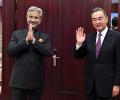
A five-point agreement was reached between Jaishankar and Wang at a meeting in Moscow on September 10 on the sidelines of a Shanghai Cooperation Organisation conclave.

The government has also relaxed certain rules to cut delays in military purchase like allowing the three services to procure required weapons and equipment from a single vendor, the sources said.
Citing media reports that China has built shelters in the Depsang area in Ladakh, the Congress on Saturday questioned the government's 'silence' over the issue and asked what steps were being taken by it to ensure status quo ante of April 2020.
The sources said the focus of the talks was to take forward the disengagement process in friction points like Hot Springs, Gogra and Depsang in eastern Ladakh.

India and China on Saturday held another round of military talks with a focus on taking forward the disengagement process in Hot Springs, Gogra and Depsang in eastern Ladakh and bring down the tensions in the region, official sources said.
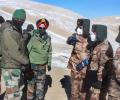
India and China on Tuesday agreed to hold the next round of the Senior Commanders meeting at an early date to achieve complete disengagement from all friction points in eastern Ladakh to create conditions for the restoration of normalcy in bilateral ties.

The high-level talks came a week after 20 Indian Army personnel were killed in a violent clash between the two sides in Galwan Valley.

The focus of the deliberations was on finalising modalities for disengagement of troops in eastern Ladakh.
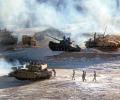
'The Chinese are only about 160-170 km behind.' 'It will not take much time for them to bring their troops back, considering that they have better infrastructure -- and the weather is now favourable.' 'They can move in much faster as the terrain favours them.'
 © 2026 Rediff.com - Advertise with us - Disclaimer - Privacy Policy - Sitemap - Feedback - About us - Terms of use - Grievances